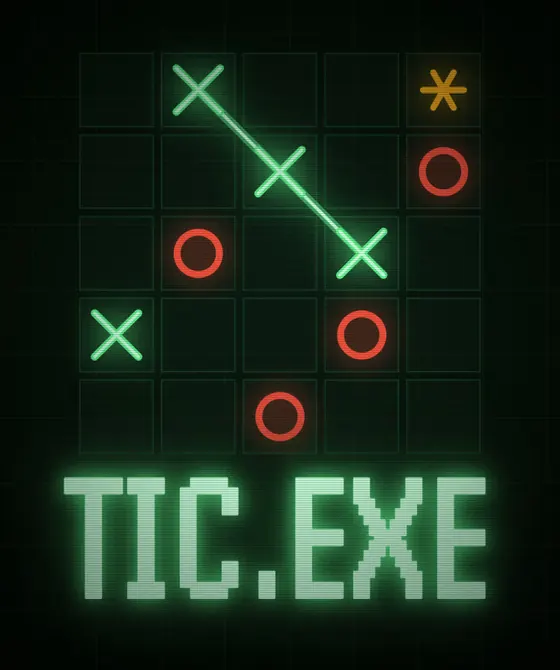
TIC.EXE
Three in a row is not a win. It is a discharge.
A tactical grid roguelite: fight hostile processes on a shifting board, build an engine out of 30 modules, and clear eight sectors before the machine answers its own launch request.
What is TIC.EXE
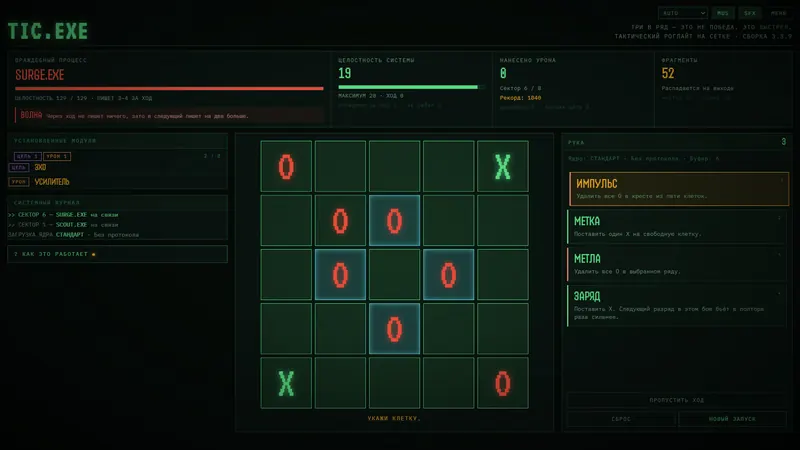
Line up three of your marks and they detonate: the marks burn, the hostile process takes the damage. A line of four hits nearly twice as hard. A line of five, three times over.
Every turn the process writes its own marks back onto the grid. If three of those ever line up, they detonate into you.
You have played tic-tac-toe since you were six. Never like this.
TIC.EXE takes a game everyone already knows and turns it into a combo machine. A line of three is not the end of the match but a discharge into a hostile process, and what happens next depends on what you bolted onto your build: echoes, infection of neighbouring cells, chain reactions, multipliers for line length.
A run spans eight sectors. After each one you pick a module and visit the terminal, where fragments buy cards, deck thinning or a wider rack. Fragments decay and prices climb, so hoarding is pointless — it is a small game of its own about when exactly to spend.
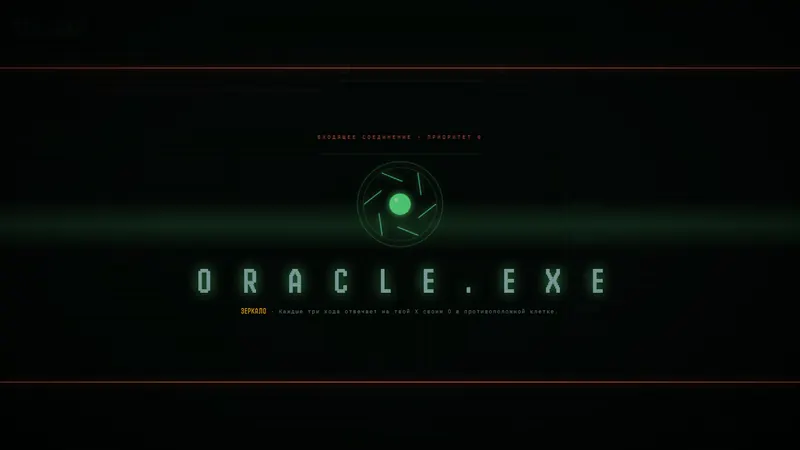
Hostile processes are drawn fresh from a pool every run: one heals while its marks hold the grid, another rewrites your marks into its own, a third charges you blood for every discharge. There is also a daily challenge — one deal for every player and one score to beat.
TIC.EXE key features
Build a machine, not a score
ECHO leaves one mark standing after every blast, INFECTION flips the enemy marks next to it, CHAIN REACTOR doubles the bonus on every step of a cascade. Two or three together become an engine.
Thirty modules, eight slots
Six schools of modules and a rack that holds only eight. When the rack is full, something has to come out.
The terminal
Fragments are data, and data rots. A quarter of everything you carry out of the shop decays on the way, and every purchase marks the market up.
Eight sectors, then the deep
Eleven hostile processes, six drawn fresh every run. Beat the core and you can stop there — or go deeper, into procedural layers that never stop climbing.
- 30 modules, 24 cards, 7 cores, 11 processes, 6 difficulty protocols
- Boards of 4×4, 5×5 and 6×6 — geometry is part of the build
- Daily challenge: one deal for everyone, one score to beat
- 25 achievements, endless mode and runs that save themselves
- Generative chiptune that thickens as you descend
TIC.EXE trailer
TIC.EXE screenshots
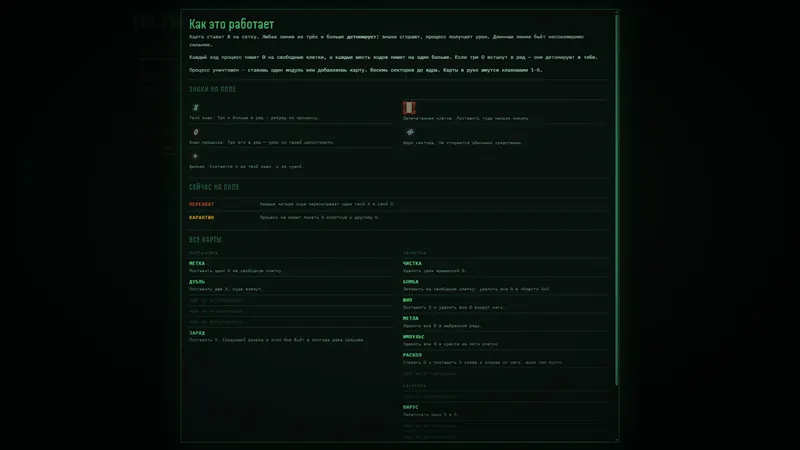
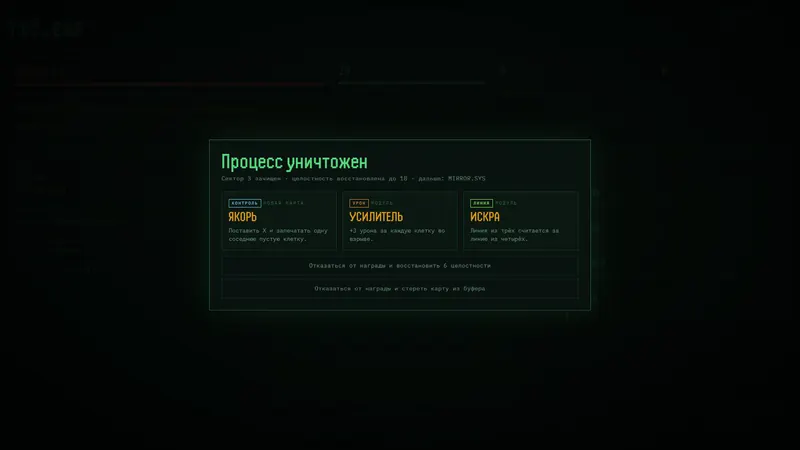
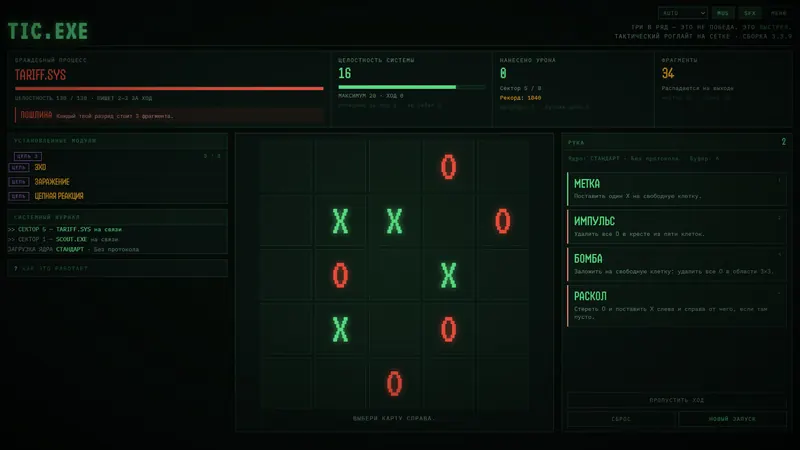
Arrows to navigate, Esc to close
TIC.EXE system requirements
Minimum
Recommended
Requirements are the ones listed by the developer on the Steam page and may change before release.
TIC.EXE FAQ
Can I play TIC.EXE on my phone?
Yes. The Android version is already out on Google Play and is free. Its interface has been rebuilt for a portrait screen and touch controls.
What is TIC.EXE?
A tactical grid roguelite grown out of tic-tac-toe. Three marks in a row do not end the match — they detonate and damage a hostile process. Over a run you assemble a machine out of modules and cards and clear eight sectors.
Is it really just tic-tac-toe?
Placing a mark really is the rule everyone knows. Everything after that is a roguelite: boards of 4×4, 5×5 and 6×6, 30 modules across six schools, 24 cards, 7 cores, 11 hostile processes and six difficulty protocols.
When does TIC.EXE release?
March 2027. The Steam page is already live: wishlist it and the store will notify you on release day and when a discount starts.
Are there daily runs and achievements?
Yes. The daily challenge is one deal shared by every player and one score to beat. There are 25 achievements, plus an endless mode and runs that save themselves.
What languages will it support?
Eight: English, Russian, German, Spanish, Brazilian Portuguese, Simplified Chinese and Japanese. The language is detected automatically and can be switched in game.